This website serves as a portal to my work on the synoptic problem, which arises from a new formal analysis of the narrative orders of the synoptic gospels.
The analysis brings to light new evidence for Griesbach’s solution to the synoptic problem; namely, that Matthew wrote first, Luke used Matthew, and Mark used Matthew and Luke.
The site will also provide some historical background to the Griesbach hypothesis (also known as the Two Gospel hypothesis) and offer a select bibliography of scholarship on the hypothesis.
Andrew Robinson, University of Exeter
Video
This video offers an overview of my formal analysis of narrative order in the synoptic gospels and of the new evidence for Griesbach’s solution to the synoptic problem that emerges from the analysis.
NB: If the video display is not crystal clear please set the resolution to 1080p (hover over the video and click on the cog-wheel icon).
Video contents:
0 mins: Introduction
1.35 The structure of Luke and Luke’s use of Matthew
8.00 A new formal analysis of narrative order
11.12 Formal analysis applied to Mark’s order
19.30 Two birds with one stone: Streeter’s curious fact
24.34 Mark’s path through Matthew and Luke
30.28 The strength of the new evidence
31.30 Narrative bridges in Mark
34.24 Final points
Article
Andrew Robinson, ‘New Observations on the Formal Coherence of Griesbach’s Solution to the Synoptic Problem’, Revue Biblique, 2025 (1), pp. 29–45.
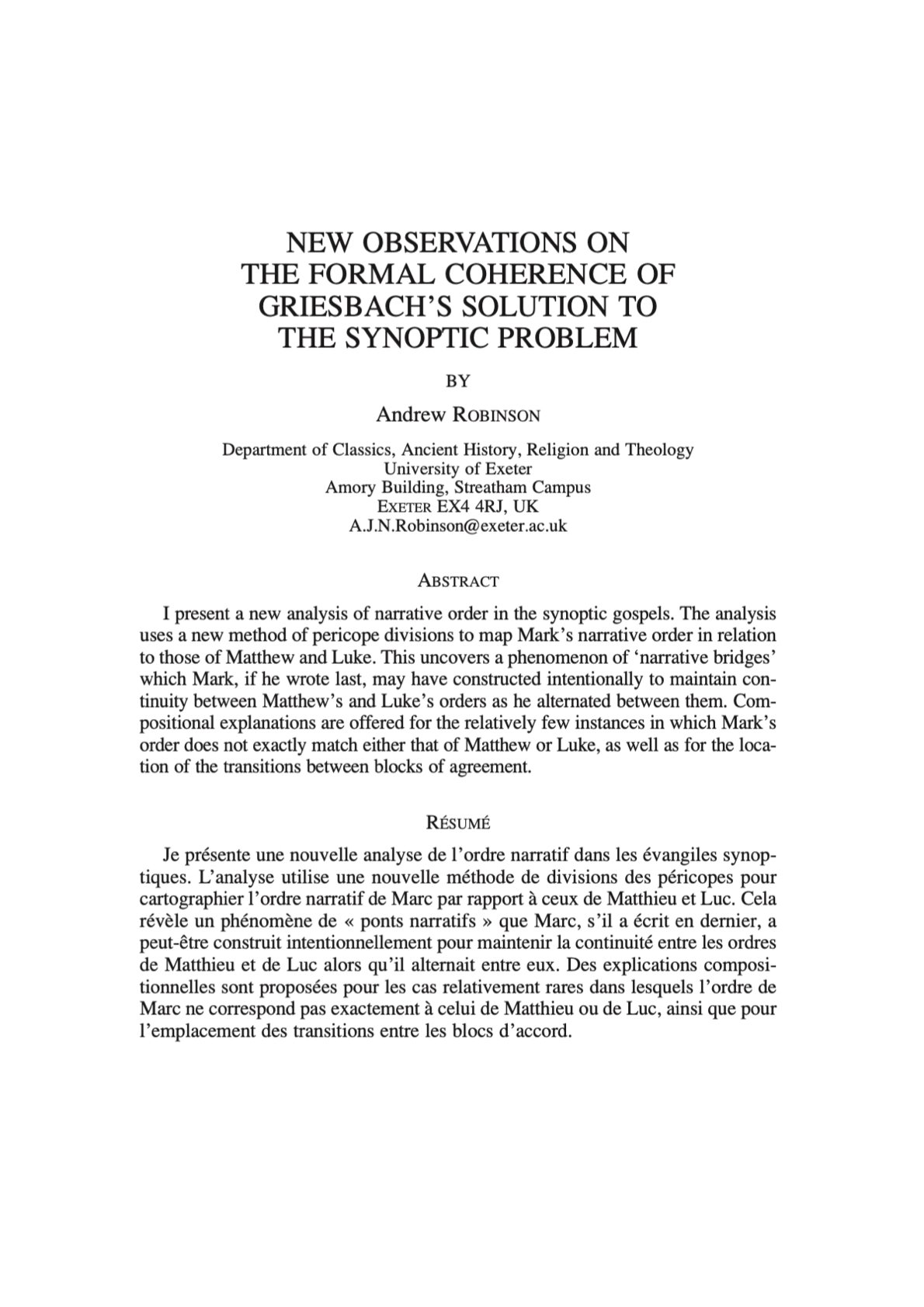
This article presents the new formal analysis of Mark’s order in relation to Matthew and Luke. It does not cover Luke’s use of Matthew or the argument from Streeter’s “curious fact”, which are presented in the video.
I can provide an electronic copy of the article for private use on request.
Work in progress
I am working on a monograph titled Narrative Order in the Synoptic Gospels: New Formal Evidence for Griesbach’s Solution to the Synoptic Problem. The monograph contains a lot of material that is not covered in either the video or the article above.
Please contact me if you would like to see any of the data in more detail.